Shopping Cart
Padel is experiencing one of the most significant periods of expansion in its history. New clubs, sustained growth in player numbers and increased investment are driving the development of the sport across Europe, the Americas and the Middle East. This growth is affecting not only courts and competitions, but also the way rackets, accessories, clothing, footwear and sports equipment are sold.
At the same time, ecommerce has profoundly transformed consumer buying habits. Today, any player can compare dozens of racket models in just a few minutes, read reviews, consult technical analyses, check prices and have a product delivered to their home within days. Immediate access to information has created a customer who is better informed, more demanding and increasingly sensitive to price.
This new environment has opened an unavoidable debate within the industry: what role should the physical padel store play in the age of ecommerce?
The answer is not the disappearance of traditional retail, but its transformation. Specialist stores, padel clubs and product display areas are moving towards a more strategic model in which the shopping experience, professional advice and direct contact with the product become the main points of differentiation.
The future is unlikely to be about choosing between physical retail and ecommerce. Instead, it will be about combining the strengths of both channels. Digital commerce provides reach, speed and ease of comparison. Physical retail provides trust, experience, direct product contact and personal guidance. When both channels work together, they create a far more complete value proposition for the player.
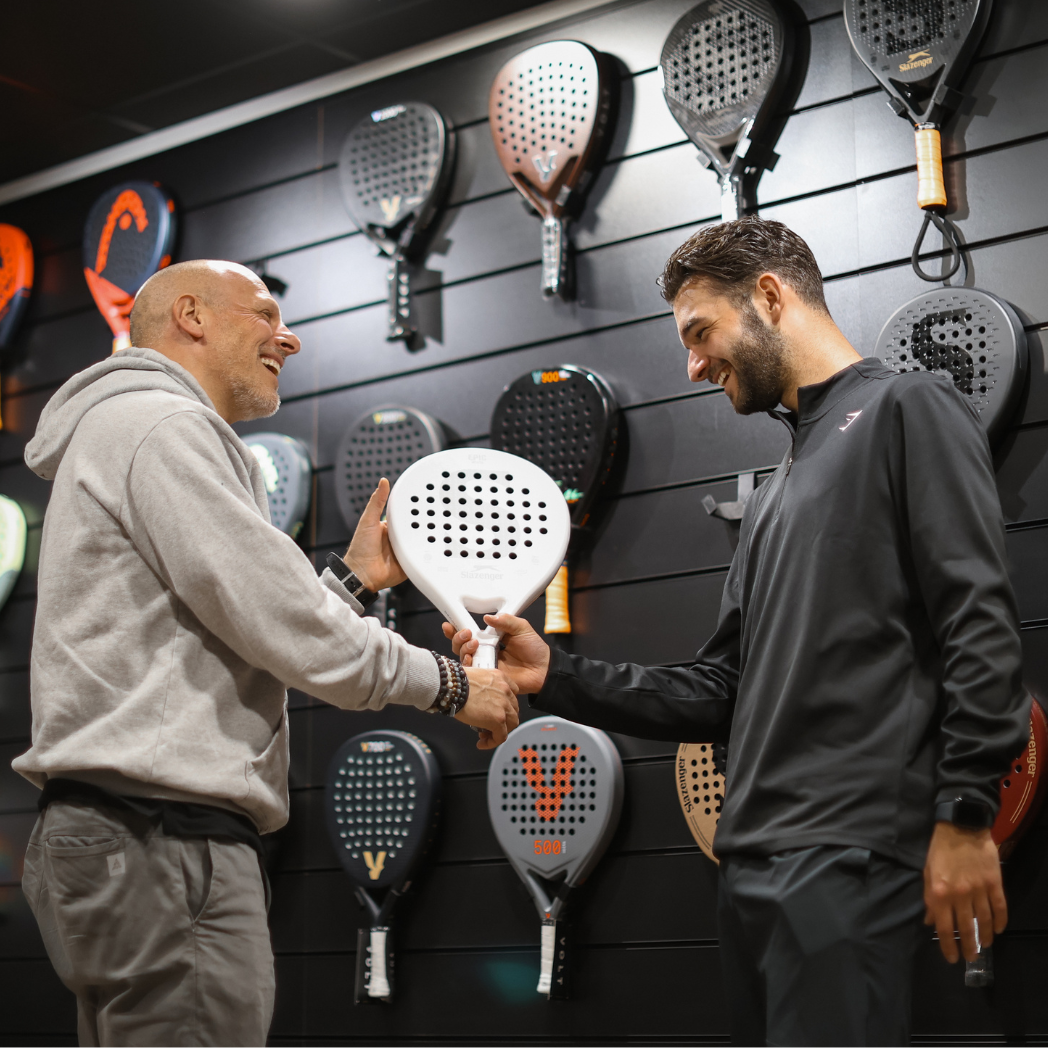
Unlike many other sporting products, a padel racket still has a strong sensory dimension. Players do not only assess price, brand or technical specifications. They also want to feel the weight, check the balance, inspect the frame thickness, evaluate the grip and imagine how that particular model will perform during play.
This is why the physical store remains a key stage in the decision-making process. Many players begin their search online, compare models and read reviews, but the decisive moment often comes when they hold the racket in their hands. That physical experience reduces uncertainty and provides a level of confidence that an online product page cannot always deliver.
Expert advice from specialist staff also continues to have considerable value. In a market with dozens of brands and hundreds of models, not every player knows how to interpret concepts such as balance, sweet spot, foam hardness, racket shape or ball output. A professional recommendation can prevent an unsuitable purchase and significantly improve customer satisfaction.
Knowledgeable staff can also guide the sale according to the player's level, playing frequency, style, physical condition and available budget. This type of support turns a simple transaction into a personalised buying experience that is difficult to replicate through ecommerce alone.
For this reason, specialist stores remain an essential part of the padel ecosystem. Their competitive advantage does not lie solely in having products available, but in helping players make better decisions.
Sports retail is evolving into a much broader concept. Specialist stores are no longer limited to stocking products and processing sales. They are creating environments where players can discover, compare, learn and experiment before making a decision.
In this new model, the commercial space must communicate expertise from the very first moment. Store layout, lighting, racket presentation, category signage and accessory organisation all influence customer perception. A well-designed store conveys professionalism, simplifies the shopping process and increases the perceived value of every product.
Many padel stores are introducing dedicated areas to strengthen customer relationships and differentiate themselves from purely digital competitors:
The store therefore becomes a meeting point between product, service and community. It is no longer simply the place where a sale is completed, but also a space where trust is built, brand identity is reinforced and long-term customer relationships are created.
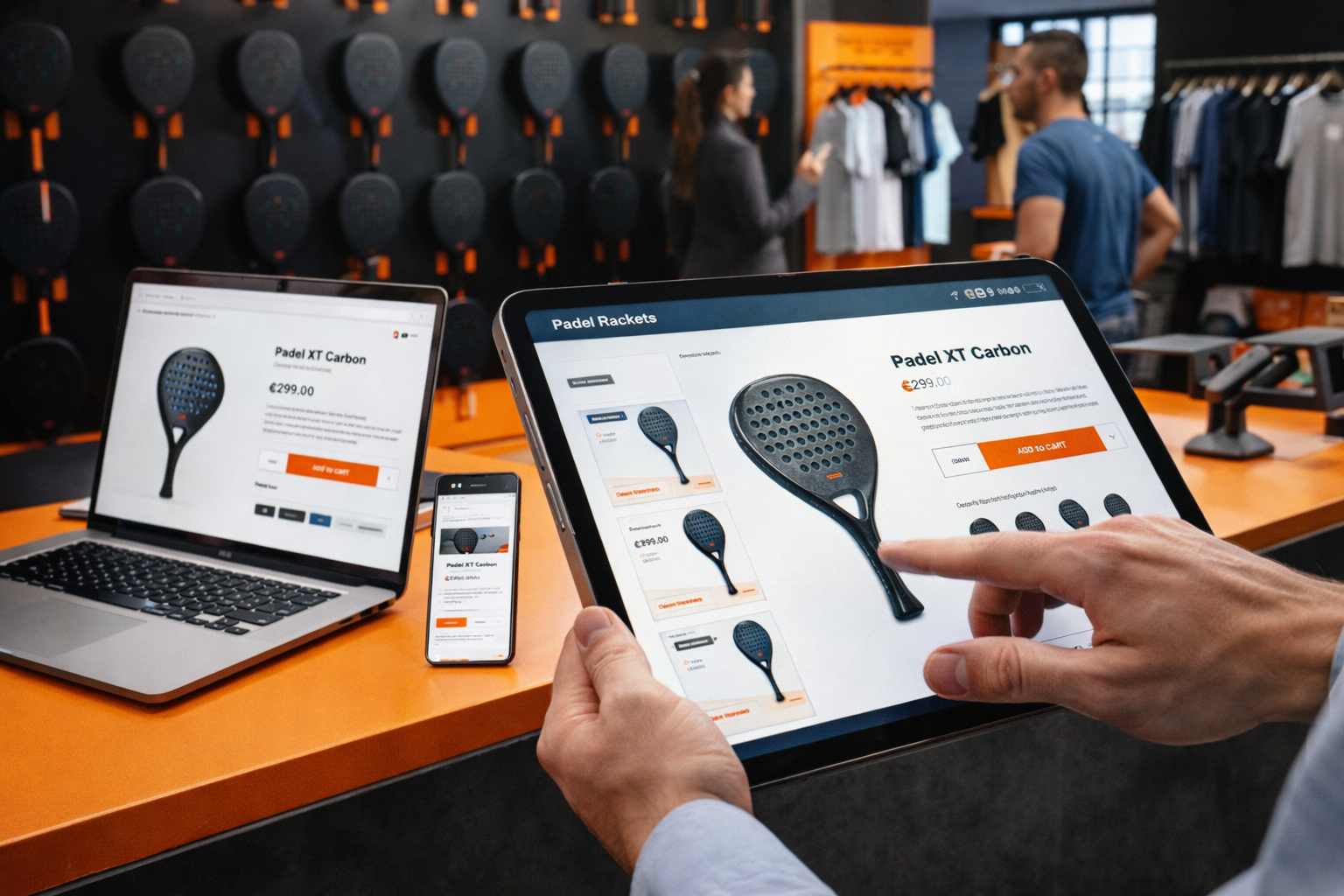
The rapid growth of ecommerce has completely changed the competitive landscape. Just a few years ago, a specialist padel shop mainly competed with other local retailers. Today, players can purchase rackets, footwear or accessories from online stores located anywhere in Europe with only a few clicks.
This new reality has increased competition, reduced retail margins and forced specialist stores to offer much more than competitive pricing. Customers are no longer looking only for products; they expect trust, availability, expert advice and a shopping experience that justifies choosing one retailer over another.
However, ecommerce should not be viewed solely as a threat. It also provides significant opportunities for growth. A physical store is no longer limited to customers who walk through its doors. With an online channel, retailers can reach players nationwide or internationally, maintain a constantly updated catalogue, promote new collections and remain accessible twenty-four hours a day.
As a result, more and more businesses are adopting omnichannel strategies where physical retail and ecommerce operate as a single commercial ecosystem. A customer may discover a racket in-store, access additional information on their smartphone, reserve it online and either collect it later or have it delivered directly to their home.
This integration removes the conflict between both channels and turns them into complementary tools. The physical store delivers confidence, personal service and product experience, while ecommerce provides convenience, availability and continuity throughout the customer journey.
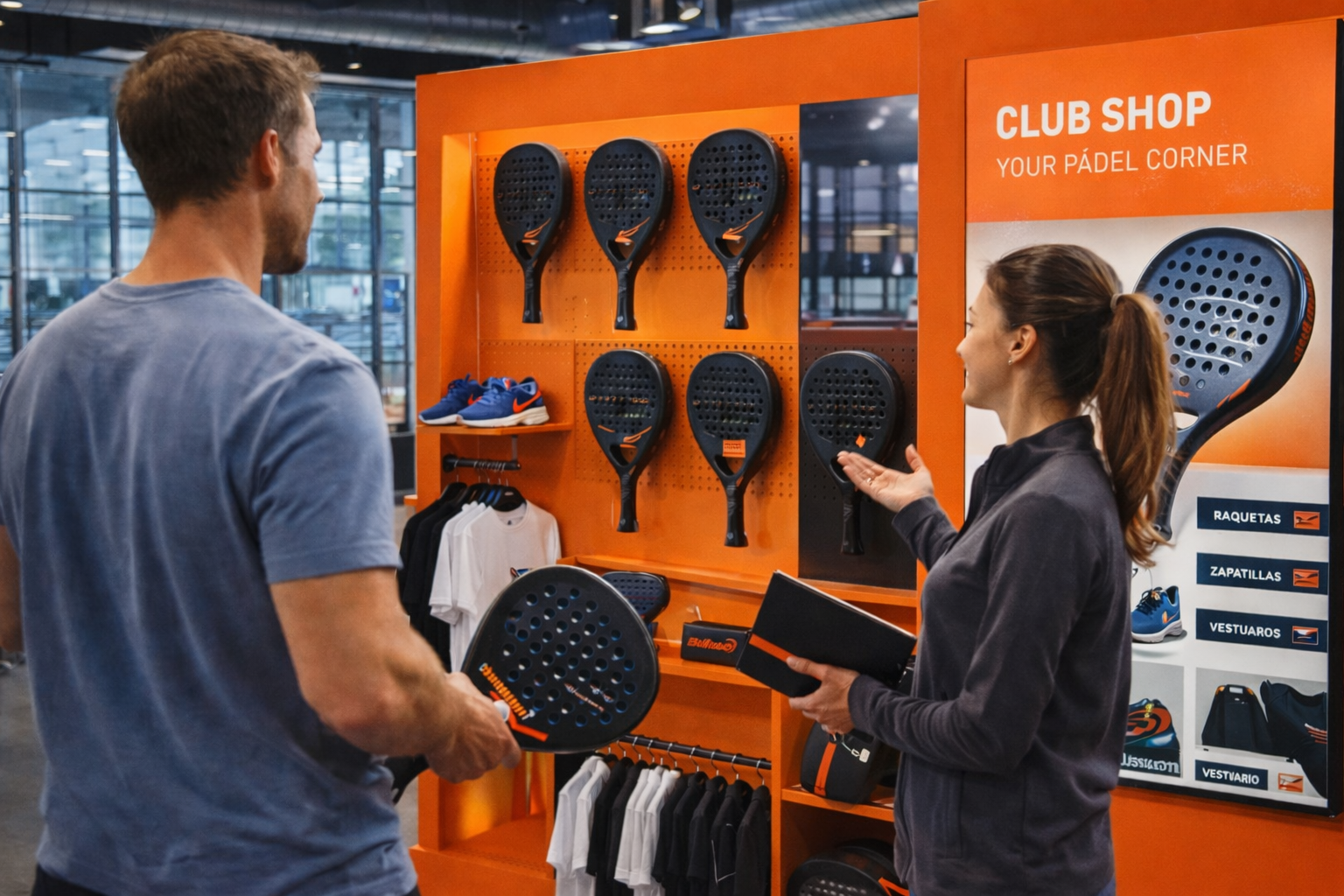
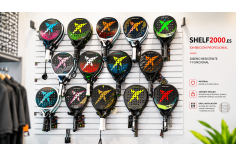
In a market where customers can compare hundreds of products from their smartphones, physical presentation has become more important than ever. A well-organised display does far more than improve the appearance of the store. It guides customers' attention, simplifies product comparison and projects a professional image that directly influences purchasing decisions.
For many years, numerous padel retailers relied on improvised display solutions. Rackets leaning against walls, unsuitable hooks and overcrowded shelves often made it difficult for customers to browse products while reducing the perceived value of the merchandise.
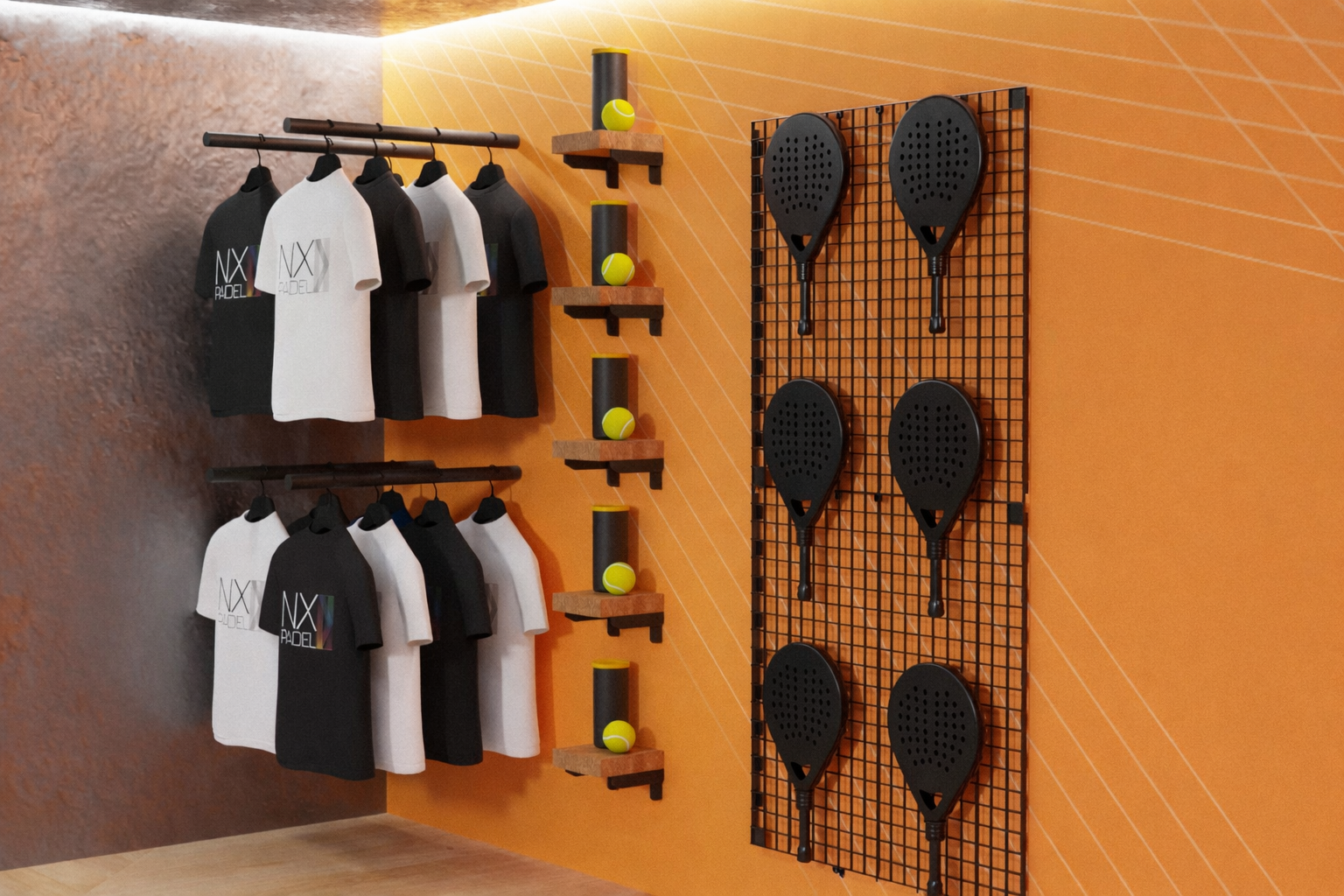
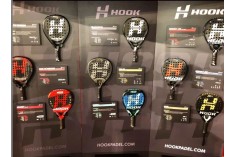
Today, the trend is completely different. Specialist retailers increasingly invest in display systems specifically designed for padel rackets, accessories, footwear and sports equipment. Every product has its own dedicated space, collections are clearly organised and customers can easily compare different models according to their playing style or skill level.
This organisation also improves the sales process. When products are displayed logically, staff can explain the differences between models more effectively, recommend suitable alternatives and encourage complementary purchases such as overgrips, racket protectors, backpacks, balls and technical accessories.
A professional presentation also strengthens brand identity while improving the overall perception of the store. Customers naturally associate a clean, organised retail environment with expertise, reliability and product quality, making them more confident throughout the purchasing process.
In this context, commercial fixtures become far more than simple furniture. They become strategic merchandising tools that communicate quality, specialisation and added value before the sales conversation even begins.
Another major transformation is taking place inside padel clubs themselves. Small retail areas, branded corners and micro-stores are increasingly being integrated into reception areas, changing rooms and social spaces.
These locations benefit from an advantage that is difficult to reproduce through other sales channels: the player is already immersed in the sport. They are thinking about padel, discussing equipment, observing what other players use and often identifying specific needs before or after a match.
A new racket, a tube of balls, an overgrip, a protector or a backpack becomes more relevant when it is presented at the exact moment the player needs it. For this reason, even a retail area with only a few square metres can generate valuable sales when it is well organised and stocked with the right product selection.
The objective is not to turn every club into a large specialist store. The most effective approach is to create a concise, visible and carefully selected offer that reflects the profile of the club's members. Best-selling rackets, fast-moving accessories and products recommended by coaches or instructors are particularly well suited to this environment.
Padel clubs also have another important commercial asset: trust. Players know the staff, value the advice of coaches and regularly share experiences with other members. This proximity creates a more natural sales process and makes recommendations feel less transactional than in many other retail contexts.
When the physical retail corner is connected to an online catalogue, the possibilities increase significantly. The club can display a carefully selected range while allowing customers to explore additional models, colours or sizes through a screen, QR code or ecommerce platform. In this way, limited floor space no longer restricts the size of the available product range.
The rapid growth of padel has attracted new brands, distributors, specialist retailers and digital operators. Product choice is expanding continuously, and customers can compare more alternatives than ever before.
This development creates opportunities, but it also increases competitive pressure. Offering good products is no longer enough. Stores and clubs need a clear value proposition that explains why players should buy from them rather than from another retailer or online platform.
Differentiation may be based on several factors, including expert advice, immediate availability, product-testing opportunities, after-sales service, rapid delivery, specialist product selection and a more convenient and professional shopping experience.
Product presentation also plays a decisive role. When rackets are organised by playing level, playing style, price range or technical characteristics, customers can compare options more easily and the retailer demonstrates genuine product expertise. By contrast, a disorganised display forces customers to interpret a complex product range without guidance and reduces the commercial effectiveness of the space.
Brands are also placing greater emphasis on visibility inside the point of sale. Customised corners, highlighted areas and dedicated displays make it easier to communicate the launch of a new collection or the benefits of a particular product range. For retailers, these solutions help organise the assortment and create clear focal points throughout the customer journey.
Competing successfully in the current market therefore requires a combination of product, information, store design, service and technology. Retailers that coordinate these elements effectively are in a stronger position to protect margins and build long-term customer relationships.
The future of the sector is unlikely to be dominated exclusively by ecommerce or by the traditional physical store. The model with the greatest potential will be the one that successfully integrates both environments and creates a continuous shopping experience, regardless of where the purchase begins or ends.
A player may discover a racket on social media, research its specifications online, test it at a club, receive advice in a specialist store and complete the purchase from a smartphone. Each of these interactions forms part of the same commercial journey.
Businesses that understand this process will be better positioned to support customers at every stage. This requires connected stock systems, consistent pricing, detailed product information, coordinated customer service and integrated after-sales support, so that the customer experiences no unnecessary barriers between physical and digital channels.
The physical store will remain relevant as long as it offers something that ecommerce cannot completely reproduce: direct contact with the product, human expertise, trust, testing and experience. Ecommerce, meanwhile, will continue to grow because of its reach, convenience and ability to offer a much broader product catalogue.
Far from disappearing, the physical point of sale will become more specialised, more visual and more digitally connected. Improvised layouts will gradually be replaced by greater attention to store planning, fixtures, merchandising and the intelligent use of technology.
In a sport as closely connected to feel and performance as padel, the physical experience will continue to play a decisive role. Product specifications, videos and customer reviews can reduce uncertainty, but they cannot completely replace the moment when a player holds a racket, checks its balance and evaluates how it feels in the hand.
For this reason, specialist stores and retail spaces inside padel clubs will retain a strategic role. Their success will depend on their ability to evolve, provide genuinely useful advice and present products in a clear, professional and attractive way.
Ecommerce does not eliminate the value of physical retail. It forces physical retail to improve. Stores that understand this transformation can use digital channels to increase their reach while using the physical environment to build trust, community and a memorable shopping experience.
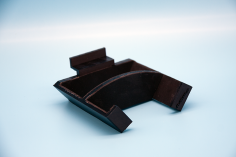
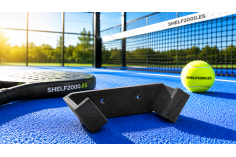
At Shelf2000, we develop display systems, commercial fixtures and modular retail solutions for padel stores and clubs. Our solutions help organise rackets, accessories, footwear and sports equipment professionally, making better use of available space and improving the presentation of every product.
A well-designed display does more than keep a store organised. It simplifies comparison, strengthens the identity of the retail environment, increases perceived product value and helps sales teams provide more effective advice.
Because in padel, as in many other sports, the purchase often begins with a simple action: picking up the racket, feeling its weight and imagining the first shot on court.
Do you need our help?