
Shopping Cart
SHELF2000 ACADEMY
Course 4 · Module 1
Is Your Padel Store Ready to Grow?
Module Objective
This module will help you evaluate whether your padel store is truly prepared for growth. Before investing in more products, advertising or store renovations, it is essential to understand your current situation and identify opportunities for improvement.
Introduction
Growing a padel store is not simply about selling more products. It means improving profitability, making better use of your retail space and creating a shopping experience that encourages customers to return.
Many retailers believe that increasing stock or introducing new brands is enough to grow their business. In reality, sustainable growth starts with analysing how efficiently the current store operates.
A store that is ready to grow offers a clear product presentation, an organised customer journey, attractive merchandising and measurable business objectives.
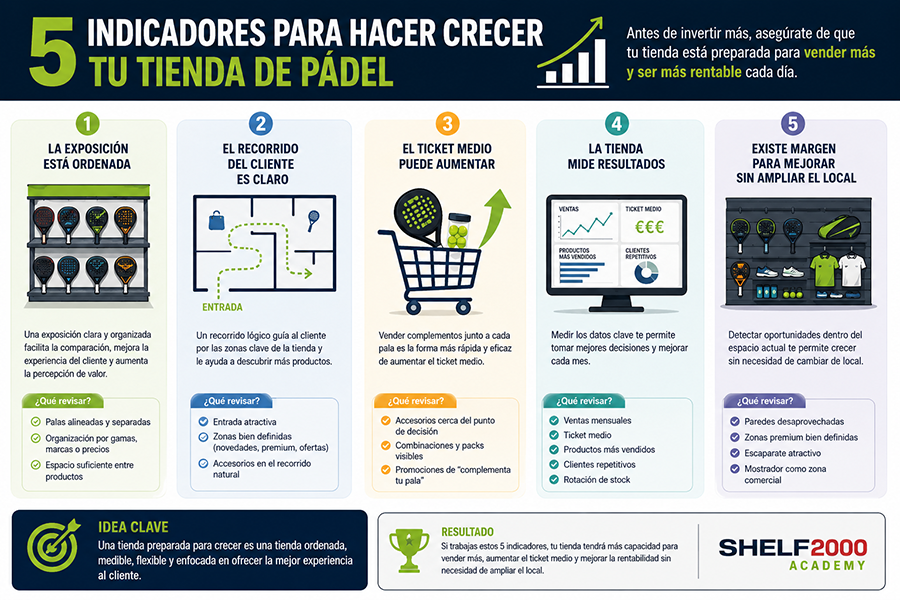
Key Idea
Before expanding your business, make sure your current store is capable of generating more sales without creating confusion, overcrowding or operational problems.
What Does Store Growth Really Mean?
Growth does not always require a larger shop. Many successful padel stores increase their turnover simply by improving the way they organise products and use their available space.
- Increase racket sales.
- Improve average transaction value.
- Sell more accessories.
- Increase profit per square metre.
- Improve customer loyalty.
- Create a stronger professional image.
- Use existing retail space more efficiently.
Five Signs Your Store Is Ready to Grow
1. Professional Product Displays
Rackets should be organised logically by brand, player level or product range, allowing customers to compare models easily.
2. Clear Customer Journey
Customers should naturally discover every important section of the store without confusion.
3. Opportunities for Cross-selling
Accessories should be positioned close to rackets to encourage additional purchases.
4. Business Performance Is Measured
Successful stores monitor sales, average order value, best-selling products and customer behaviour.
5. Room for Improvement
There should still be opportunities to optimise walls, premium areas, display systems and merchandising.
Shelf2000 Recommendation
Before investing in additional stock, optimise your existing retail space. Better merchandising often produces faster results than increasing inventory.
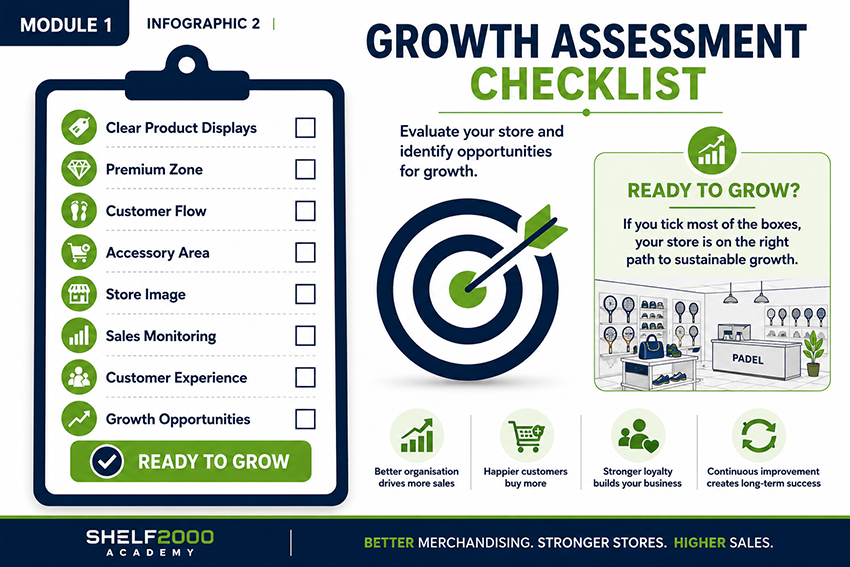
Quick Self-Assessment
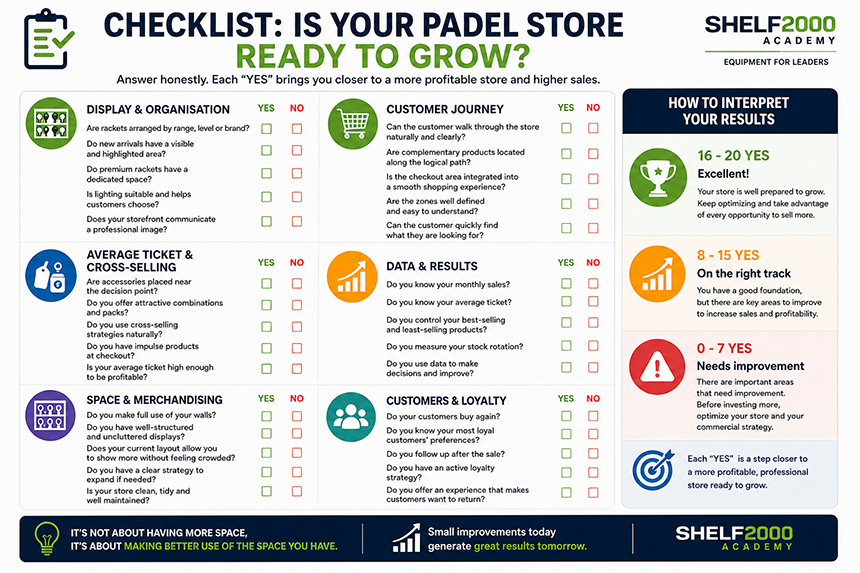
☐ Is your racket display clearly organised?
☐ Do customers naturally follow your store layout?
☐ Are premium products highlighted?
☐ Are accessories displayed beside rackets?
☐ Do you monitor sales performance?
☐ Does your store create a professional first impression?
Module Summary
Business growth starts with understanding your current situation. Before investing in more products or more space, ensure that your existing store is organised, measurable and capable of generating higher sales.
A professional retail environment creates confidence, improves customer experience and builds long-term profitability.
Knowledge Check
1. Does business growth always require a larger store?
A) Yes.
B) No, better organisation often delivers better results.
2. Why should accessories be displayed near rackets?
To increase cross-selling opportunities.
3. Why should retailers monitor performance?
Because better decisions are based on measurable data.
Next Module
Module 2 · How to Increase Sales Without Expanding Your Store
Discover practical merchandising techniques to increase sales by making better use of your existing retail space.
SHELF2000 ACADEMY
Course 4 · Module 2
How to Increase Sales Without Expanding Your Store
Module Objective
Learn how to increase sales by making better use of your existing retail space. This module explains how merchandising, product presentation and store organisation can significantly improve business performance without increasing the size of your shop.
Introduction
Many retailers believe that a larger store automatically means higher sales. In reality, some of the most successful padel stores generate excellent results from relatively small spaces.
The difference lies in how efficiently every square metre is used. Better displays, improved customer flow and organised product categories can dramatically increase sales without major investment.
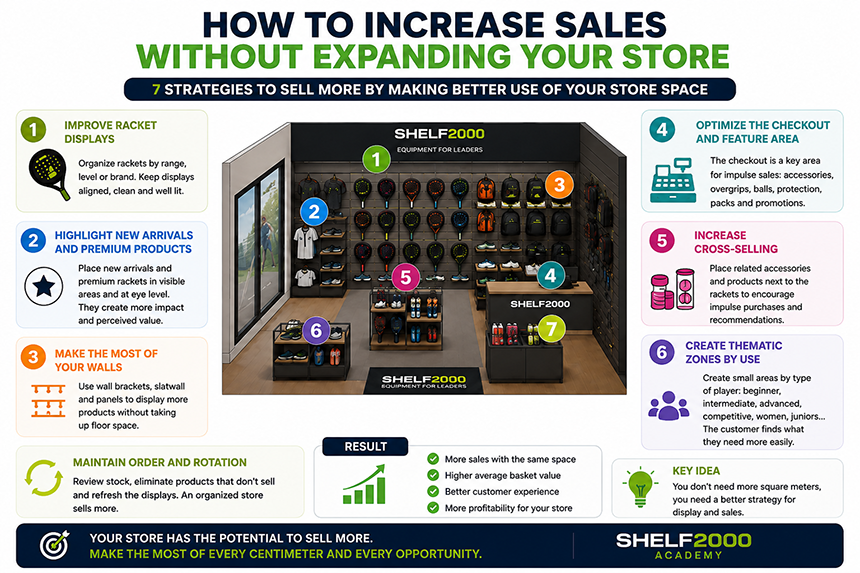
Every Square Metre Should Generate Sales
Every wall, display and product location should contribute to your business objectives.
- Use wall displays to maximise product capacity.
- Reduce unnecessary furniture.
- Create open customer pathways.
- Highlight premium products.
- Group related products together.
- Improve product visibility.
Key Idea
Increasing retail efficiency is often more profitable than increasing retail space.
Improve Vertical Merchandising
Wall-mounted display systems allow you to present more padel rackets while keeping the shop organised and spacious.
Vertical displays also improve product comparison and help customers make purchasing decisions more quickly.
Organise Products by Category
Customers should immediately understand where to find each product group.
- Beginner rackets.
- Intermediate rackets.
- Professional rackets.
- Premium collections.
- Bags.
- Shoes.
- Accessories.
- Clothing.
A logical layout improves customer confidence and creates a more professional shopping experience.
Promote High-Margin Products
Your most visible retail areas should be reserved for products that generate the greatest value for your business.
- New collections.
- Premium rackets.
- Special promotions.
- Exclusive products.
- Seasonal offers.
Reduce Visual Clutter
Too much furniture and overcrowded displays make products less attractive.
A cleaner store appears larger, more organised and easier to shop.
Increase Cross-Selling Opportunities
Accessories should always be displayed close to the main products.
Customers purchasing a racket frequently also need:
- Overgrips.
- Balls.
- Protective tape.
- Bags.
- Backpacks.
- Padel shoes.
Real Example
A 70 m² padel shop replaced bulky furniture with vertical display systems.
The result was:
- More rackets on display.
- Better customer circulation.
- Improved product visibility.
- Higher accessory sales.
The store increased its sales without expanding its retail space.
Common Mistakes
- Leaving walls unused.
- Overcrowding displays.
- Mixing different product categories.
- Ignoring premium display areas.
- Keeping the same layout all year.
Shelf2000 Recommendations
✔ Maximise wall space.
✔ Create clean product displays.
✔ Highlight premium collections.
✔ Keep customer pathways clear.
✔ Refresh merchandising regularly.
✔ Make every display work as a silent salesperson.
Module Summary
Increasing sales does not always require a larger shop.
Professional merchandising, efficient product displays and intelligent use of retail space allow padel stores to improve profitability while maintaining the same physical footprint.
Knowledge Check
1. What is often more profitable than expanding a store?
Improving the use of existing retail space.
2. Why are vertical displays important?
They increase display capacity while saving floor space.
3. Where should accessories be displayed?
Close to the main products.
4. What should occupy the best display areas?
High-margin and premium products.
Next Module
Module 3 · The Customer Journey in a Padel Store
Discover how store layout influences customer behaviour and how a well-designed shopping journey can increase sales.
SHELF2000 ACADEMY
Course 4 · Module 3
The Customer Journey in a Padel Store
Module Objective
Understand how customers move through a padel store and learn how to create a shopping journey that improves product visibility, encourages exploration and increases sales opportunities.
Introduction
The moment a customer enters your padel store, they begin making decisions. Within seconds they form an opinion about your business, your products and the overall shopping experience.
A well-designed customer journey helps visitors discover more products, spend more time inside the store and purchase with greater confidence.
Successful merchandising is not about forcing customers to follow a path. It is about creating a natural flow that guides them towards the products you want them to see.

Why Is the Customer Journey Important?
The customer journey directly influences purchasing behaviour.
A logical layout encourages visitors to discover more products naturally while making the shopping experience easier and more enjoyable.
Key Idea
A better customer journey leads to longer visits, more product interactions and higher sales.
The Five Key Areas of a Successful Store
1. Store Entrance
The entrance creates the first impression. It should be clean, welcoming and immediately communicate the identity of your business.
2. New Arrivals Area
Customers are naturally attracted to new products. Position them where they are impossible to miss.
3. Main Racket Display
This is the most important area of the store. Rackets should be organised by category, player level or collection to simplify comparison.
4. Accessories Area
Accessories should be positioned close to the main racket displays to encourage additional purchases.
5. Checkout Area
The checkout should also function as a retail display, presenting impulse-buy products such as grips, balls and protective accessories.
Common Mistakes
- Blocking customer circulation.
- Overcrowding the entrance.
- Mixing unrelated product categories.
- Poor lighting in key areas.
- Leaving important walls underused.
- Creating confusing store layouts.
Real Example
Two padel stores sell the same brands.
The first has a confusing layout where customers often miss important products.
The second follows a logical customer journey with a clear entrance, a premium racket wall, accessories placed near the main displays and an attractive checkout area.
The second store consistently achieves higher customer engagement and better sales performance.
Shelf2000 Recommendations
✔ Keep entrances open and welcoming.
✔ Use your main wall for premium racket displays.
✔ Position accessories beside rackets.
✔ Maintain wide and comfortable walkways.
✔ Refresh displays throughout the year.
✔ Guide customers naturally through the entire store.
Module Summary
A successful customer journey improves both the shopping experience and business performance.
When customers can easily navigate the store, compare products and discover complementary items, sales increase naturally without additional advertising or extra retail space.
Knowledge Check
1. What creates the customer's first impression?
The store entrance.
2. Where should premium rackets be displayed?
On the main display wall.
3. Why should accessories be positioned near rackets?
To increase cross-selling opportunities.
4. What is the main purpose of a customer journey?
To guide customers naturally through the store while increasing product visibility and sales.
Next Module
Module 4 · Hot and Cold Zones in a Padel Store
Learn how to identify your store's highest-performing retail areas and transform underused spaces into profitable sales zones.
SHELF2000 ACADEMY
Course 4 · Module 4
Hot and Cold Zones in a Padel Store
Module Objective
Understand how different areas of your padel store influence customer behaviour and learn how to maximise every square metre by placing the right products in the right locations.
Introduction
Not every area of a retail store performs equally. Some locations naturally attract customers, while others receive little attention.
Understanding these hot and cold zones allows you to position products more effectively, improve customer flow and increase sales without changing the size of your store.
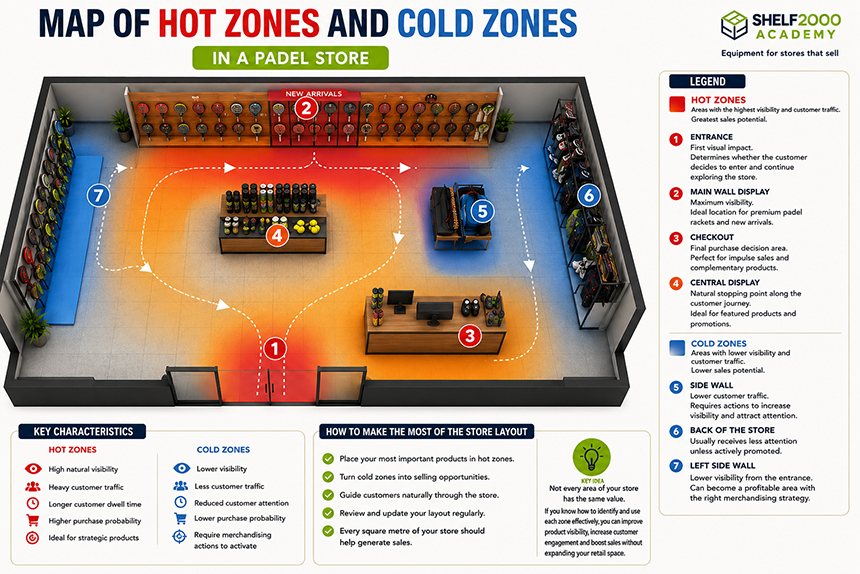
What Are Hot Zones?
Hot zones are the areas where customers naturally spend more time or pay greater attention.
- Main entrance.
- Primary display wall.
- New arrivals area.
- Main customer pathway.
- Checkout area.
- Premium product displays.
Key Idea
Use your hottest retail areas to display your most profitable products.
What Are Cold Zones?
Cold zones are areas that receive little customer attention. These spaces often include hidden corners, poorly lit walls or locations away from the natural customer flow.
Cold zones should never be ignored. With better merchandising they can become valuable selling areas.
How to Improve Cold Zones
- Improve lighting.
- Add promotional displays.
- Create themed product areas.
- Install vertical display systems.
- Rotate products regularly.
- Improve store signage.
Shelf2000 Recommendation
Wall-mounted display systems help transform underused walls into attractive merchandising areas while keeping the shop organised and spacious.
Common Mistakes
- Displaying premium products in hidden areas.
- Ignoring poorly lit spaces.
- Leaving walls empty.
- Keeping the same merchandising all year.
- Using oversized furniture.
Quick Checklist
☐ Have you identified your hot zones?
☐ Are premium products displayed there?
☐ Have you improved your cold zones?
☐ Are your walls fully utilised?
☐ Is customer flow natural?
☐ Do customers easily discover new products?
Module Summary
Understanding hot and cold retail zones allows you to make better merchandising decisions.
By placing the right products in the right locations, you can significantly improve customer engagement and sales without increasing retail space.
Knowledge Check
1. What is a hot zone?
An area where customers naturally pay more attention.
2. What can improve a cold zone?
Better lighting and improved merchandising.
3. Where should premium products be displayed?
In the hottest areas of the store.
4. Why are wall displays important?
They maximise retail space while improving product visibility.
Next Module
Module 5 · How to Build Customer Loyalty in a Padel Store
Learn how to turn first-time buyers into loyal customers through excellent service, professional merchandising and continuous customer engagement.
SHELF2000 ACADEMY
Course 4 · Module 5
How to Build Customer Loyalty in a Padel Store
Module Objective
Learn how to create long-term customer relationships that increase repeat purchases, improve customer satisfaction and strengthen the reputation of your padel store.
Introduction
Winning a new customer requires time, effort and investment. Keeping an existing customer is far more profitable.
Successful padel stores understand that customer loyalty is built through excellent service, professional product presentation and consistent communication.
Customers who enjoy a positive shopping experience are more likely to return, recommend your business and purchase additional products over time.
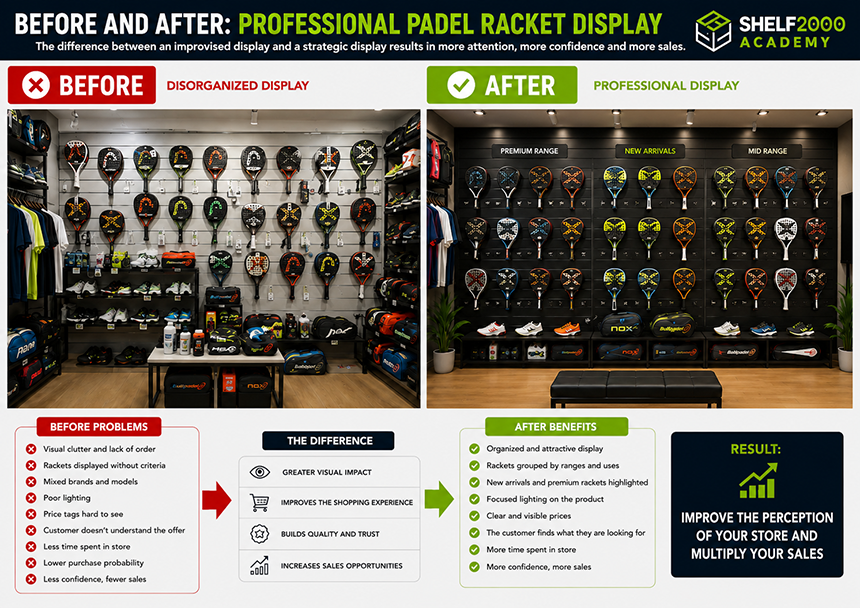
Why Customer Loyalty Matters
Loyal customers purchase more frequently, trust your recommendations and often become ambassadors for your business.
- Higher lifetime customer value.
- More repeat purchases.
- Greater customer trust.
- Lower marketing costs.
- More word-of-mouth recommendations.
- Stronger business stability.
Key Idea
A satisfied customer is your most effective marketing tool.
Six Ways to Build Customer Loyalty
1. Deliver Outstanding Service
Professional advice and genuine interest create trust.
2. Keep Your Store Well Organised
A clean and professional retail environment improves customer confidence.
3. Follow Up After Every Sale
A simple message after purchase strengthens customer relationships.
4. Refresh Product Displays Regularly
Frequent visual updates encourage customers to return.
5. Communicate Consistently
Newsletters, social media and WhatsApp help maintain regular contact.
6. Work With Local Padel Clubs
Partnerships with clubs create long-term customer acquisition opportunities.
Common Mistakes
- Ignoring existing customers.
- Only communicating during promotions.
- Providing inconsistent customer service.
- Keeping outdated product displays.
- Failing to build customer relationships.
Real Example
Two padel stores sell similar products.
The first only focuses on attracting new customers.
The second maintains regular contact with previous buyers through newsletters, new product launches and special events.
After one year, the second store has developed a loyal customer base that generates consistent repeat business.
Shelf2000 Recommendations
✔ Build a customer database.
✔ Send regular newsletters.
✔ Promote new product launches.
✔ Organise in-store events.
✔ Cooperate with local padel clubs.
✔ Reward loyal customers.
Quick Checklist
☐ Do you know your regular customers?
☐ Do you communicate with them regularly?
☐ Are new products clearly promoted?
☐ Do customers receive excellent service?
☐ Does your store encourage repeat visits?
☐ Do you cooperate with local clubs?
Module Summary
Customer loyalty is one of the most profitable investments any padel retailer can make.
By creating positive shopping experiences and maintaining long-term relationships, your business becomes stronger, more profitable and less dependent on constantly attracting new customers.
Knowledge Check
1. Why is customer loyalty important?
Because loyal customers buy more often and recommend your business.
2. What builds customer trust?
Professional service and consistent communication.
3. Why should retailers contact customers after a purchase?
To strengthen long-term relationships.
4. What is one of the best sources of new loyal customers?
Recommendations from satisfied customers.
Next Module
Module 6 · Building a Growth Plan for Your Padel Store
Bring together everything you have learned throughout the course and create a practical action plan to grow your padel business over the next twelve months.
SHELF2000 ACADEMY
Course 4 · Module 6
Building a Growth Plan for Your Padel Store
Module Objective
Bring together everything you have learned throughout this course and create a practical action plan to grow your padel store in a structured, measurable and sustainable way.
Introduction
Successful retail businesses do not grow by chance. They grow because they define clear objectives, monitor performance and continuously improve the shopping experience.
A well-structured growth plan helps you prioritise investments, organise merchandising, improve customer service and achieve long-term business goals.
Step 1 – Evaluate Your Current Situation
Start by analysing your store objectively.
- Store organisation.
- Product presentation.
- Customer journey.
- Hot and cold zones.
- Store image.
- Average transaction value.
- Sales performance.
Step 2 – Set Realistic Business Goals
Your objectives should be specific, measurable and achievable.
- Increase annual sales.
- Improve average order value.
- Sell more accessories.
- Increase customer loyalty.
- Strengthen your professional image.
- Improve merchandising quality.
Shelf2000 Recommendation
Focus on two or three priority objectives before starting new projects. Consistent progress delivers better long-term results than trying to improve everything at once.
Step 3 – Define Your Action Plan
Every objective should be supported by practical actions.
- Improve wall merchandising.
- Create a premium racket display.
- Install professional display systems.
- Refresh product layouts regularly.
- Strengthen digital communication.
- Develop partnerships with local padel clubs.
Step 4 – Measure Your Results
Review your performance every month.
- Total sales.
- Average transaction value.
- Best-selling products.
- Customer retention.
- Accessory sales.
- Profitability per square metre.
Common Mistakes
- Changing strategy too frequently.
- Not measuring results.
- Ignoring merchandising.
- Trying to change everything at once.
- Neglecting customer experience.
Real Example
A padel retailer sets three realistic objectives for the coming year:
- Increase annual sales by 15%.
- Improve average order value.
- Create a premium display area for high-end rackets.
By improving merchandising, customer experience and retail organisation, the business achieves sustainable growth without expanding its premises.
Your Personal Growth Plan
☐ My main objective this year:
___________________________________________
☐ My first three actions:
1. ______________________________
2. ______________________________
3. ______________________________
☐ Target completion date:
___________________________________________
Course Summary
Throughout this course you have learned how to analyse your store, improve merchandising, optimise customer flow, identify hot and cold retail zones, build customer loyalty and create a practical business growth strategy.
Long-term success is achieved through continuous improvement, professional product presentation and a customer-focused retail experience.
Congratulations!
You have successfully completed Course 4 – Growing Your Padel Store.
You now have the knowledge to improve your retail space, increase profitability and deliver a better shopping experience for every customer.
The Shelf2000 team thanks you for completing this course and wishes you every success in developing your padel business.