Shopping Cart
Padel breaks boundaries: the FIP 2025 report confirms
the largest global expansion in the sport’s history
FIP World Padel Report 2025 · Global growth analysis
Padel has reached a global turning point. What was, barely two decades ago, a sport concentrated in Spain and a few Latin American countries has become one of the fastest-growing disciplines worldwide.
The FIP World Padel Report 2025 presents solid data that marks a before and after in the history of this sport. According to the report, padel now exceeds 35 million active players worldwide. This figure, impressive for any discipline, is even more remarkable for a sport that is still young in terms of its international structure.
Growth is not limited to recreational play. The formal structure and organised competition are also strengthening. Federated players have increased by 42 % compared with the previous year, a leap that reflects growing professionalism and the maturity of national and international institutions.
The report shows that this momentum is closely linked to infrastructure development. In just one year, the number of padel clubs grew by 16.1 %, while the total number of courts increased by 15.2 %. This evolution not only meets current demand, it also lays the foundations for stable and sustained expansion.
Wherever courts are built, padel takes root; and once it takes root, it demands more services, more professionals and more equipment. Around the sport, a specific economy emerges that includes manufacturers, installers, equipment brands, specialist retailers, clubs, coaches, academies and digital platforms.
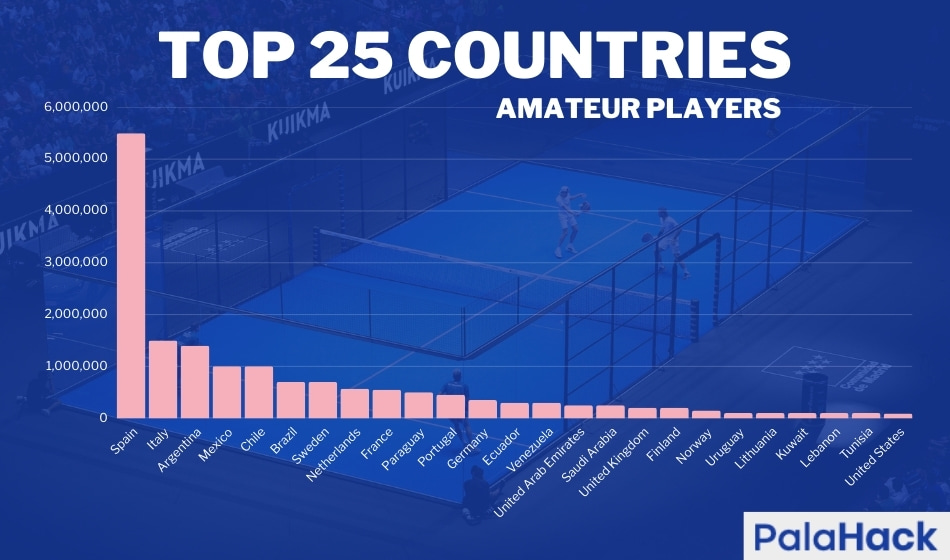
The most revealing aspect, however, is the geographical distribution of growth. Until recently, padel was largely a European phenomenon, with Spain as the undisputed epicentre, supported by emerging markets such as Italy, Sweden and Portugal. Latin America, led by Argentina and Mexico, reinforced this growth from the other side of the Atlantic.
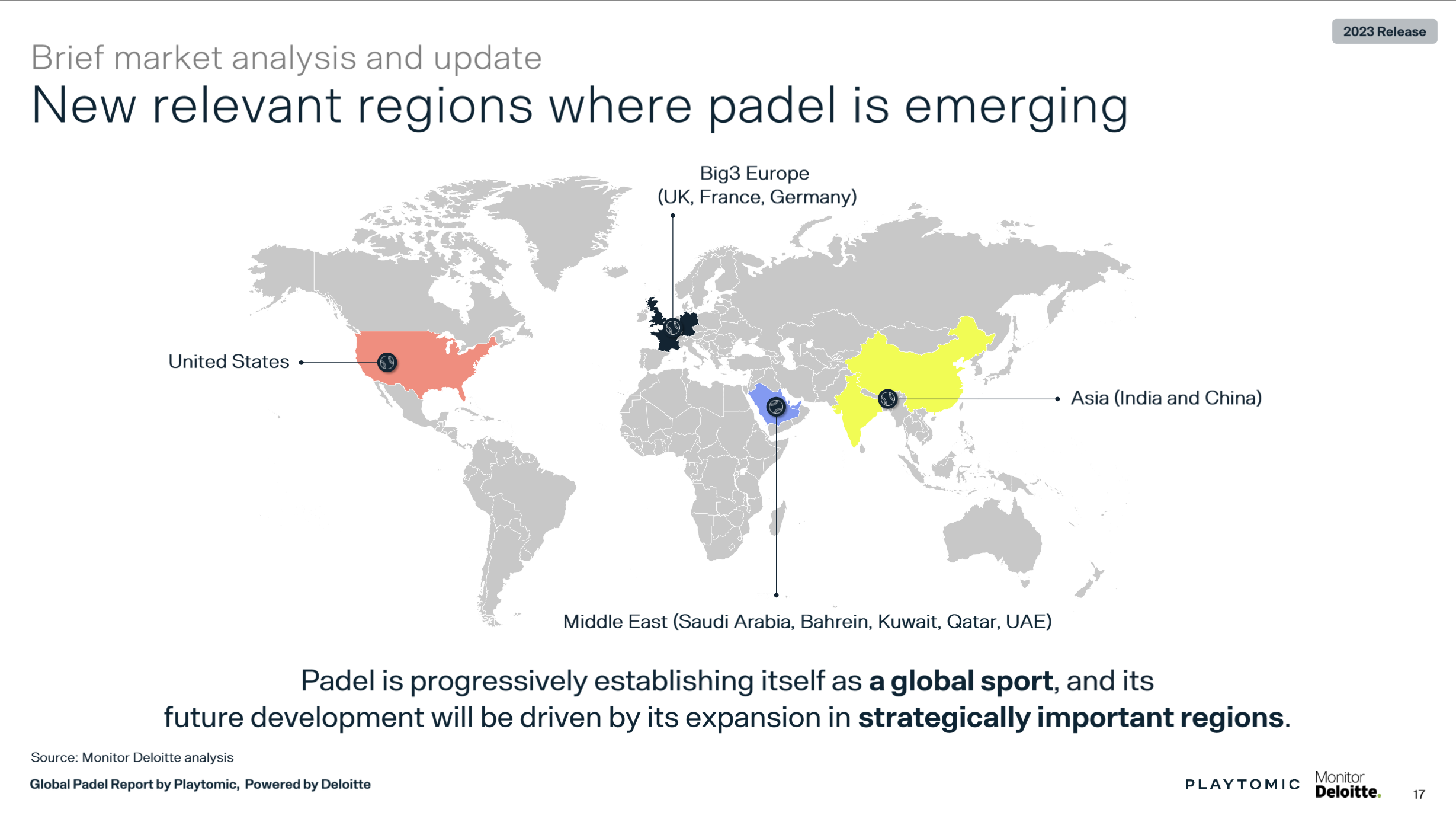
The 2025 report shows a major shift: growth is no longer regional, but truly global. Padel is expanding rapidly in Africa, where countries such as Egypt, Morocco and South Africa are boosting both recreational practice and the development of private clubs and sports complexes.
In Asia, strategic markets like Japan, South Korea, India and the United Arab Emirates are showing unprecedented dynamism. A combination of private investment, high-end residential projects and institutional initiatives is positioning padel as a flagship sport in new urban developments and next-generation sports centres.
In the Middle East, countries such as Saudi Arabia and Qatar are integrating padel into their broader strategies for social and leisure diversification. The sport is being incorporated into large multi-sport facilities, hotels and residential complexes, reinforcing the idea of active leisure linked to wellbeing and community life.
One of the most significant developments is the rise of padel in North America. The United States and Canada are adopting the sport as an alternative and complement to tennis and pickleball. Celebrities, investors and private clubs are supporting projects that present padel as an attractive, social and highly promising sport in a market with high purchasing power.
This global scale directly affects the sport’s economy. As the number of players grows and more courts are built, the ecosystem of services widens: from the design and construction of facilities to technical equipment, club management, specialised training and the digitalisation of bookings, competitions and performance data.
The consolidation of the professional circuit acts both as a showcase and as a driver. International tournaments, live broadcasts and sponsorship agreements increase padel’s visibility and fuel public interest. Professionalisation demands better facilities, more performance technology and an ever more robust organisational structure.
In this context, Europe and Latin America remain essential pillars, but they are no longer alone. The entry of dozens of new countries in Africa, Asia, the Middle East and North America has turned padel into a diverse sport, capable of adapting to different cultures and lifestyles.
The FIP World Padel Report 2025 makes it clear that this growth is not a passing trend, but the consolidation of a sport that fits perfectly in today’s society: agile, easy to learn, social, intergenerational and compatible with urban life. Padel preserves its essence while embracing new markets, new technologies and new ways of experiencing sport.
With all this data on the table, the message is emphatic: padel is not the future of sport; it is its most dynamic present. Everything suggests that, in the coming years, it will continue to set historic records in number of players, facilities, investment and global relevance.