Shopping Cart
There are no more items in your cart
The reception desk also sells: how to turn the club’s first space into a profitable commercial area
In many padel clubs, the reception area is still treated as a simple transit zone. Reservations are managed, matches are paid for, calls are answered, and issues are resolved. All of that is necessary, of course, but limiting this space to a purely administrative role means wasting some of the most valuable square meters in the entire club. The reception area is the player’s first point of contact, the place where first impressions are formed, and, when handled properly, it can also become a real tool for image and sales.
Padel has evolved enormously in recent years. Today’s player compares rackets, pays attention to the club’s aesthetics, notices details, and values spaces that convey order, professionalism, and good judgment. It is no longer enough to simply have products available; they must be presented properly. And that is exactly where a well-designed reception area makes the difference between a club that merely serves customers and a club that also communicates, recommends, and sells.
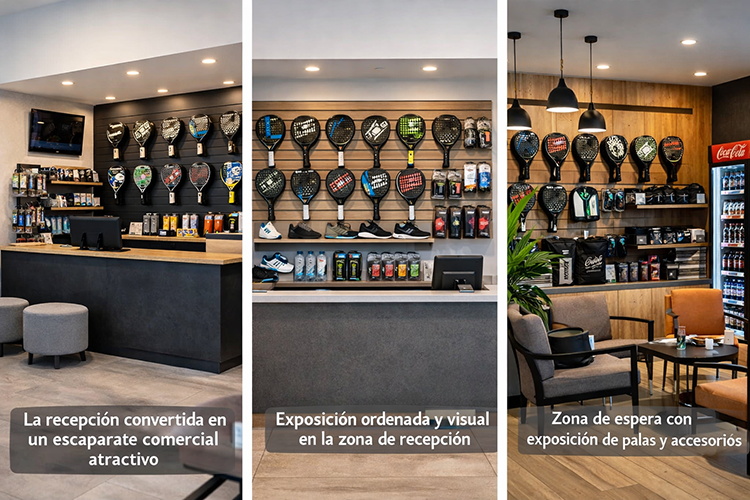
Padel club reception area with an organized display of rackets, accessories, and customer service zone.
When a player enters a club, even if they are only there to play for an hour, their eyes scan the space. They look at the counter, the lighting, the cleanliness, the signage and, almost without realizing it, the displayed equipment as well. If they see a well-presented racket, a clean selection of accessories, or a carefully arranged product display, they pause. That visual pause is the starting point of many buying decisions. There is no need for the purchase to happen immediately; it is enough for the player to remember the model, ask about it, or associate it with a professional image of the club.
The reception area has one advantage that no other part of the club possesses so clearly: it concentrates traffic, waiting time, and attention. This is where players arriving early for their match, customers asking about lessons, companions waiting around, and members with a few spare minutes all come together. All of this traffic creates opportunities. If the product is displayed properly, the reception desk stops being just a workspace and becomes a quiet, constant, and highly effective commercial point.
Moreover, this transformation does not require costly renovations or major construction work. In most cases, what is needed is judgment. Choosing the right products to show, deciding how to organize them, understanding which visual height is most attractive, and using a display system that presents the merchandise in a clean, stable, and professional way. The difference between a racket simply leaning somewhere and a racket displayed correctly is enormous. In one case there is improvisation; in the other, there is commercial intent.
The reception area should not be filled with products. It should only show what deserves to be seen, remembered, and asked about.
Visual order, product selection, and a sense of professionalism
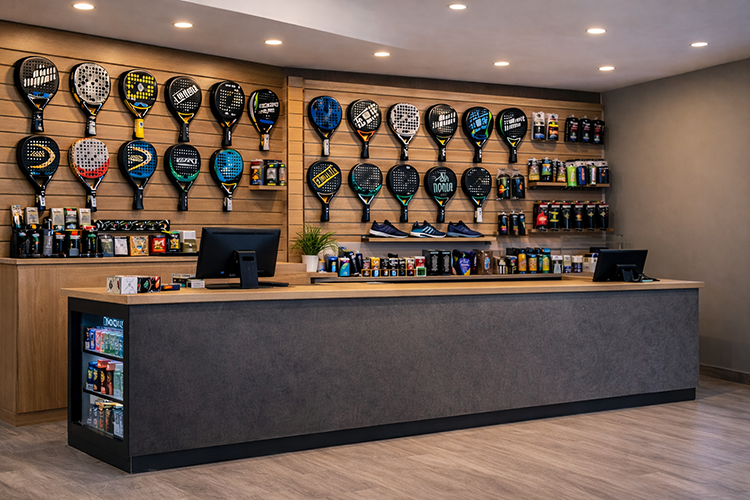
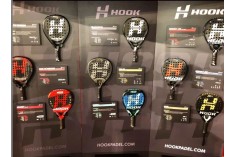
Reception counter with wall panel for displaying rackets and fast-moving accessories.
One of the most common mistakes in many clubs is trying to display too many things at once. When everything is visible, nothing truly stands out. The player needs visual hierarchy. They need to understand at a glance what deserves attention and what is simply there as a complement. That is why a good reception area does not try to look like a large store. It does something better: it summarizes, guides, and presents clearly.
Strategic rackets, for example, work especially well in this environment. New arrivals, standout models, high-turnover references, or products the club wants to recommend are natural candidates for the main display area. Around them, with order and without visual overload, overgrips, protectors, ball cans, small accessories, or even footwear can coexist if space allows. What matters is not the quantity, but the visual readability of the whole setup.
When the product is properly organized, the counter works better and so does the club staff. Conversation becomes easier. The customer asks by pointing, the receptionist explains quickly, and the recommendation gains strength because it is supported by something visible. This assisted, direct, and simple sale has enormous value in padel, where many decisions are based on trust, advice, and real contact with the playing environment.
There is also an image factor that should not be overlooked. A well-designed reception area not only improves product sales; it raises the club’s overall perception. It conveys order, attention to detail, and a clear intention to do things properly. And in a market where more and more clubs are competing, that matters far more than is sometimes assumed.
For years, in many specialist sectors, products have sold better when they have been presented well. This is not a recent trend or a passing idea. It is a classic commercial principle. Good display organizes the eye, adds value to the product, and helps the customer decide. Padel, which has grown at remarkable speed, now also needs to recover that culture of commercial detail. And the reception area is one of the best places to start.
The player experience begins before stepping onto the court

Waiting area integrated with reception and commercial display inside a padel club.
There is a very valuable moment that many clubs still do not fully take advantage of: the minutes before a match. The player arrives, waits for their partner or opponents, checks their phone, sits down, looks around, and absorbs whatever is in front of them. That waiting time, which at first glance seems like dead time, is actually a perfect opportunity for the club to showcase products, reinforce its identity, and activate commercial interest without being intrusive.
When the reception area is integrated with a small, well-resolved waiting zone, the effect is even better. The customer does not feel as though they are being aggressively sold to. They simply spend time in a pleasant, organized, and functional space where the equipment has a natural presence. The display stops feeling forced and becomes part of the club itself. That generates familiarity and, with it, trust.
At this point, visual consistency is essential. The furniture, lighting, finishes, and display supports must all speak the same language. If the space conveys cleanliness and professionalism, the product gains value on its own. On the contrary, if the reception area looks improvised, cluttered, or poorly resolved, even a good racket loses commercial strength. The environment directly influences product perception.
That is why any club that wants to get the most out of its reception area must think of it as a sum of functions: customer service, organization, image, and sales. It is not about turning the entrance into a bazaar or overwhelming the player the moment they walk through the door. It is about making sure each element has a reason to be there. That the displayed racket invites questions. That the visible accessory encourages a quick extra purchase. And that the whole setup reinforces the feeling of being in a serious, modern, and well-run club.
At heart, the idea is simple. The reception area already exists. The traffic already exists. The waiting time already exists. The smart move is to put those square meters to work. In a sector where every detail matters, making good use of the reception area is a practical, profitable decision and fully consistent with the evolution of modern padel.
From that perspective, the professional display of rackets and accessories is not decoration or an aesthetic whim. It is a commercial tool. It helps improve the club’s image, makes recommendations easier, organizes the product, and turns an everyday zone into a point of value. And when this is done well, the player notices it from the very first moment, even before stepping onto the court.
A small space, a big opportunity
The profitability of a padel club does not depend only on court bookings. Increasingly, it also depends on how complementary spaces are used and how the customer experience is built from the moment they enter until they leave. The reception area, so often underestimated, actually has enormous potential to strengthen the club’s brand and open up an additional revenue stream.
When the product is well displayed, when the space breathes order, and when presentation supports the service, the club gains both in image and in commercial efficiency. There is no need to complicate it further. Sometimes, the difference between a correct space and a profitable one simply lies in knowing how to present well what you already have.
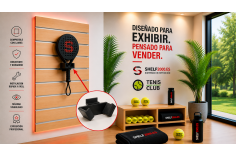
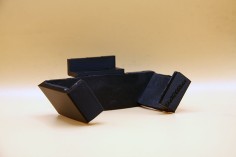
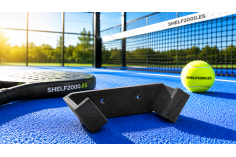
At Shelf2000, this is exactly the idea we work on: helping padel clubs and specialized stores present their rackets better, organize their display, and turn every square meter into a real commercial opportunity. Because in today’s padel market, it is not only what you sell that matters, but also how you present it.